Tulum Ruins Tours: The Complete Guide
Everything you need to book a Tulum ruins tour in 2026: the new 265-peso entry fee, opening hours, tour types by departure point, and how to beat the crowds.
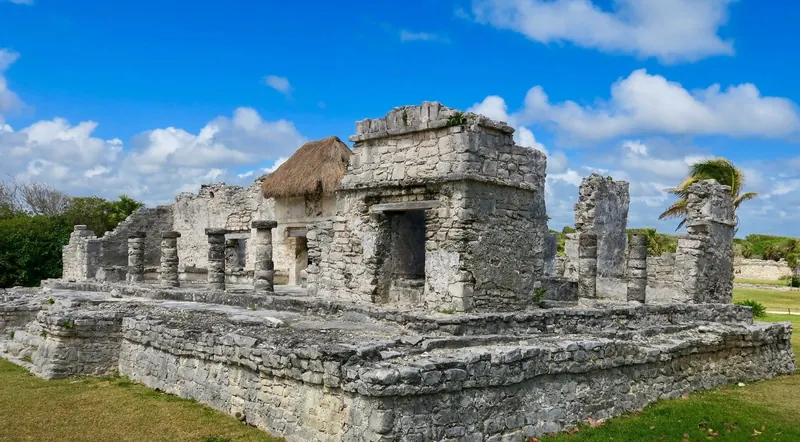
Tulum is the only Maya city built on a cliff above the Caribbean, and that single fact explains both why it’s one of Mexico’s most-visited archaeological zones and why so many first-time visitors come away with mixed feelings. The setting is extraordinary. The site itself is compact, entirely roped off, and can get uncomfortably crowded by mid-morning.
Book an early departure and you see El Castillo against an empty sea; arrive at 11:00 and you spend two hours shuffling through a queue in full sun. This guide covers the July 2026 fee change, what a Tulum ruins tour buys you, and how to pick one based on where you’re staying.
Tulum Ruins Tours at a Glance
| Opening hours | Daily 08:00–17:00 |
| Last admission | 15:30 |
| Entry cost, foreign visitors | 265 pesos (about $15) |
| Entry cost, Mexican nationals | 80 pesos Mon–Sat; free Sundays |
| Time inside the site | 1–2 hours |
| Time to allow from Tulum town | 2–3 hours, including the 1 km entrance walk each way |
| Day trip from Cancún | Most of a day; the drive is 1.5–2 hours each way |
| Can you climb the pyramids? | No, all structures are roped off |
| Best arrival time | 08:00, at opening |
Hours and fees checked against INAH’s Tulum page in October 2026. Government fees change, so confirm before you travel; our full tickets and fees guide has the charge-by-charge breakdown.
Other Experiences You Might Enjoy
If Tulum is one stop on a Riviera Maya trip, pair the ruins with a swim at Cenote Mariposa, the sea turtles at Akumal, a day at Chichén Itzá or Cobá, or a boat trip into Sian Ka’an.
What Changed in 2026: The New Entry Fees
If you researched Tulum before mid-2026, discard what you found on pricing. A federal decree took effect on 20 July 2026 and restructured every charge at the site, and the rates are fixed through the end of 2027. The old system stacked an INAH zone fee on top of separate national park and Parque del Jaguar charges, which pushed foreign visitors past 500 pesos. That structure no longer applies.
What you pay now
Foreign visitors pay 265 pesos in total, the figure INAH publishes for the zone. Our tickets guide explains how that total is collected at the booths. Mexican nationals and residents pay 80 pesos Monday to Saturday and enter free on Sundays.
Several groups enter free with valid physical ID, including minors, seniors, people with disabilities, pensioners, teachers and students, and accredited guides. Bring the original document; photos on a phone are often refused.
Bring cash in pesos. Card terminals at the gate are unreliable, and small bills help because the booths often can’t break large notes.
Sundays at the ruins
Free Sunday entry for Mexican nationals can make Sunday busier with domestic visitors, though INAH publishes no day-of-week counts. A foreign visitor pays the same fee every day, so if your dates are flexible, pick a weekday.
What Parque del Jaguar is
Inaugurated in late 2024, Parque del Jaguar bundles several federal protected areas around Tulum into one managed complex: the Tulum national park, the Jaguar flora and fauna protection area, and the archaeological zone itself. On arrival you’ll find a visitor services area, a regional museum, a restored lighthouse, forest trails, a lookout point and cycle paths. The ruins now sit at the center of a larger park, and you no longer drive straight up to the walls.
Parking, the walk and the shuttle
The main entrance sits at km 230 of Highway 307. There is paid parking near the entrance and a free lot about a kilometer further out. From parking to the ticket booth is roughly 1 km, or 10–15 minutes on foot. A small tram covers that stretch for a fee; it is not run by INAH, so the price varies, and electric buses also circulate inside the park. A southern access road and parking area were announced in the 2026 recovery plan; check whether it has opened before you rely on it.
Is a Tulum Ruins Tour Worth It?
A tour is optional here. Tulum is a compact site, roughly 380 by 165 meters, and every structure is roped off, so there’s nothing to climb. Most visitors are done inside in about 90 minutes. If you’re picturing Chichén Itzá’s scale, Tulum isn’t that; see our Tulum vs Chichén Itzá comparison if you’re weighing the two.
Tulum’s draw is the setting: a walled Maya port city on 12-meter limestone cliffs, with the Caribbean behind El Castillo. It photographs like nowhere else in the Maya world.
A tour earns its price in three ways:
- Timing. Good operators reach the gate near opening. The tour-bus wave usually lands around 10:00, and the site is at its busiest from about 11:00 until mid-afternoon.
- Logistics. The driving, the parking, the entrance walk and the cash-only fee booths are handled for you.
- Context. Roped-off ruins with sparse signage are easier to follow with a guide. Without one, Tulum can read as a pretty pile of stones.
A tour does not reliably get you past the queue; more on that below.
Types of Tulum Ruins Tours
Guided ruins-only tours
Half-day trips: transport or a meeting point, then a guided walk through the site, usually finished by early afternoon. This is the format to book if you only want the ruins and want your day back.
Our pick: the Tulum: Archaeological Zone Guided Walking Tour (from $17, 4.9/5 from 110 reviews), a 75-minute walk that starts at the site. Check whether your chosen option includes the entry fee or leaves it to pay in cash on the day. Our full breakdown of the walking tour covers the meeting point and what the guide shows you.
Ruins and cenote combinations
The most popular format, and a sensible pairing: the ruins in the cool of the morning, a cenote swim when the heat peaks. If a cenote is included, wear reef-safe sunscreen, and expect to rinse off before entering at many cenotes. See our breakdown of which cenotes the tours visit.
Our pick from Cancún: the From Cancun: Tulum Ruins, Cenote Mariposa & Playa del Carmen (from $34, 4.6/5 from 457 reviews). If you’re staying in Tulum or Akumal and want a smaller group, the Tulum: Ruins, 2 Secret Cenotes and Mexican Lunch (Small Group) (from $165, 5.0/5 from 35 reviews) costs about $130 more and adds lunch and a second cenote. Prefer to cycle? The Tulum: Guided Bike Tour of Tulum Ruins, Tacos & Cenote (from $109, 4.9/5 from 13 reviews) rides from town, though 13 reviews is a small sample.
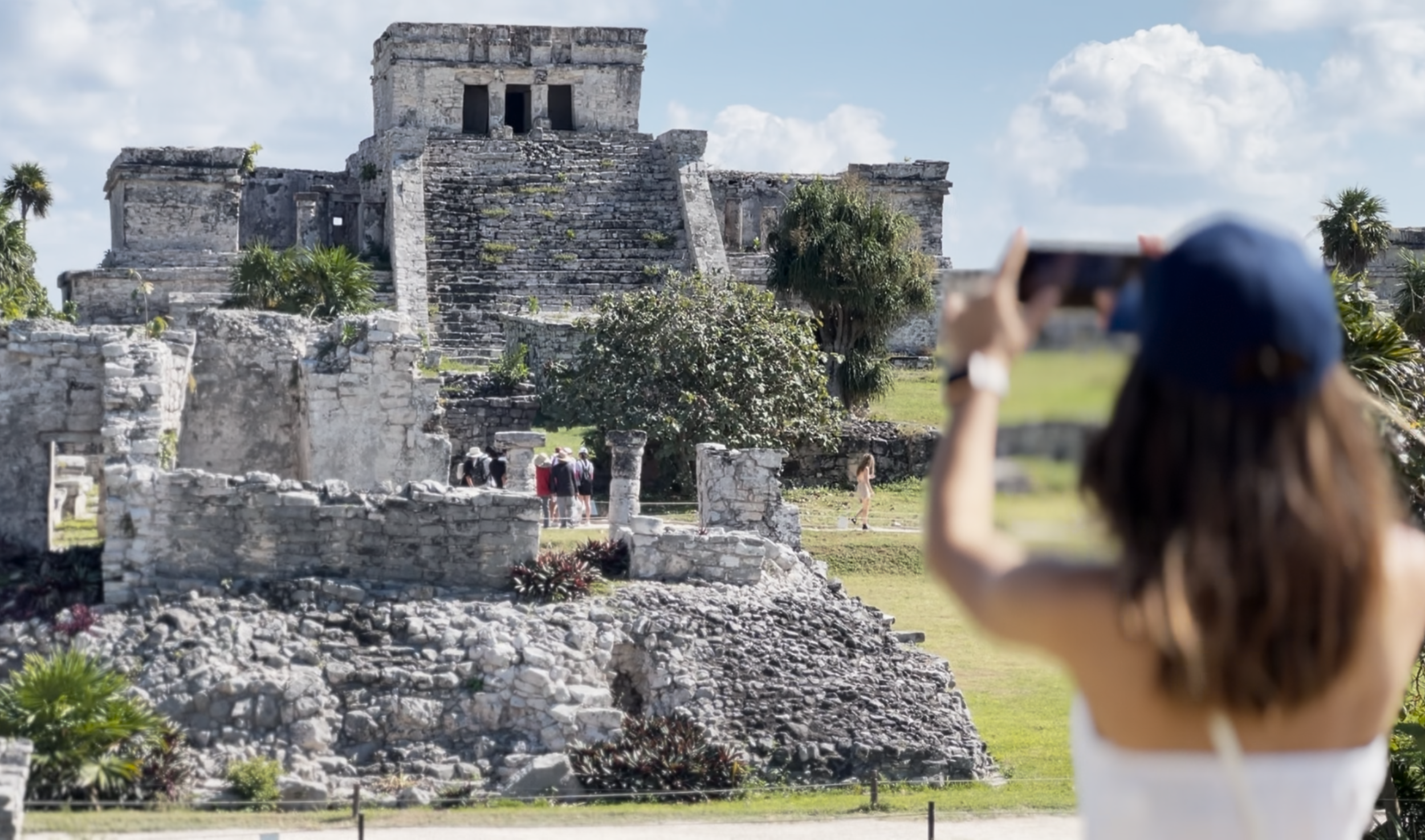
From Cancun: Tulum Ruins, Cenote Mariposa & Playa del Carmen
A half-day combo covering the ruins, a swim at Cenote Mariposa, and a stop in Playa del Carmen, the most-booked cenote pairing on this list.
Adding Cobá
If you’re disappointed that Tulum can’t be climbed, Cobá is the contrast: a jungle site about 45 minutes inland, where the Nohoch Mul pyramid reopened to climbers in December 2025. GetYourGuide has no single listing that covers both sites, so most visitors book the Tulum half and reach Cobá on their own. Our Tulum and Cobá guide explains how to fit both into one day.
Chichén Itzá as a separate day
Operators generally advise against squeezing Tulum and Chichén Itzá into a single day: the driving distances leave limited time at either site. Plan them as two days. For the Chichén day, the Cancun: Chichen Itza, Cenote & Valladolid Tour with Lunch (from $57, 4.6/5 from more than 8,600 reviews) leaves from Cancún and does not stop at Tulum. We cover the trade-offs in our Tulum and Chichén Itzá tour guide.
Ruins with snorkeling at Akumal
These pair the archaeological zone with a cenote and a snorkel with the sea turtles at Akumal. You get more variety for the price, but count the total travel time on the longer itineraries. Our pick is the From Cancun: Tulum and Akumal Cenote and Turtle Swim Tour (from $84, 4.5/5 from 376 reviews).

From Cancun: Tulum and Akumal Cenote and Turtle Swim Tour
Pairs the ruins with a cenote swim and sea turtle snorkeling at Akumal. Pick it if wildlife matters more to you than a second Maya site.
Private, small-group and large-bus tours
Group size matters more to your day than any other choice. Large-bus operators can carry dozens of people and collect passengers from many hotels before heading south. Small-group and private tours depart earlier, carry fewer people, and spend less of the day on pickups. Our private vs group tours guide compares the three in detail.
For a private guide, the Tulum: Get a Private Guide to Show You the Mayan Ruins (from $82, 4.5/5 from 13 reviews) sets the pace around your group; with only 13 reviews, read the recent ones before booking. For a small group with cenotes and lunch, see the $165 small-group tour above.
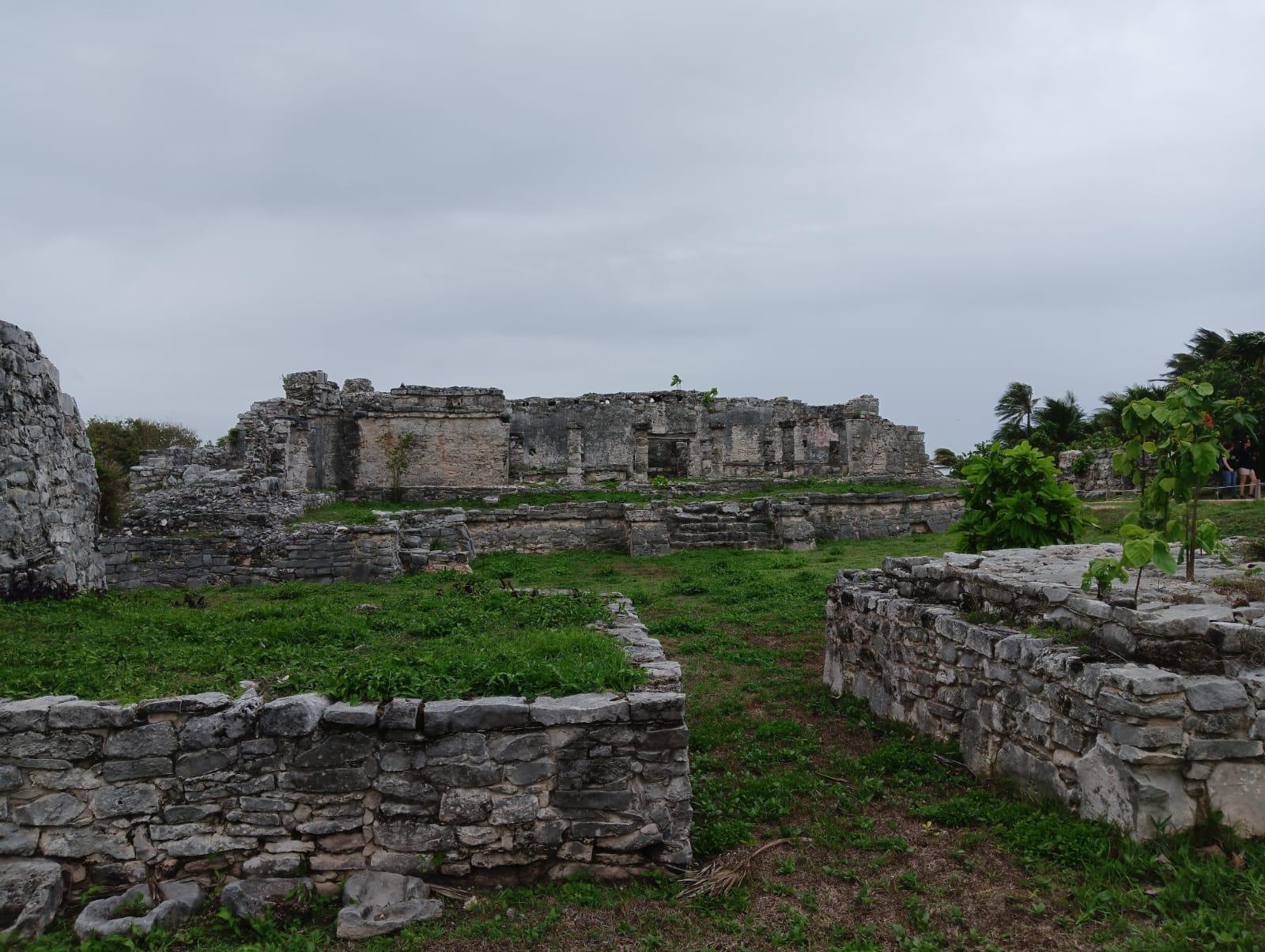
Tulum: Get a Private Guide to Show You the Mayan Ruins
A private guide for your group only, with full control over pace and timing, and no waiting on other travelers or a fixed departure time.
Self-guided with transport only
Take a colectivo or ADO bus to the entrance and hire a certified guide on arrival. INAH-accredited guides work near the ticket booth, offering roughly 90-minute to two-hour tours in several languages for a fee paid in cash. This is the cheapest route and gives you full control over timing, but you handle the logistics yourself. See our guided vs. self-guided comparison for the full breakdown.
Visiting from a Cozumel cruise stop
Feasible, but count the hours: a ferry to Playa del Carmen, roughly an hour’s drive each way, and typically about two hours at the ruins. Most of the day is transit, so it works best when you aren’t trying to fit in much else. Details in our guide to visiting the Tulum ruins from Cozumel.
Where Tours Depart From
| Departure point | Distance | One-way travel time |
|---|---|---|
| Cancún | ~130 km | 1.5–2 hours |
| Playa del Carmen | ~60–65 km | 1–1.5 hours |
| Riviera Maya resorts | varies | 45 min–1.5 hours |
| Tulum town | ~4 km | 10 minutes |
| Cozumel | ferry + drive | ~2 hours |
Tours also run from Akumal and Puerto Morelos along the Highway 307 corridor. Departure guides: from Cancún · from Playa del Carmen · from the Riviera Maya resorts. For every way of getting there, see our complete guide to getting to the Tulum ruins.
If you’re staying at a Riviera Maya resort, the From Riviera Maya: Tulum Ruins, Cenotes & Jungle Adventure (from $199, 4.9/5 from 19 reviews) picks up along the corridor and adds cenotes and a jungle park; 19 reviews is still a small sample.
“Skip the Line” and Early Access: What’s Real
Treat these claims skeptically. The queue at Tulum forms at the ticket booth, and voucher holders frequently still join it. In some cases they still pay the government fee in cash on arrival, because the voucher covered the tour and not the entry. Travelers also report confusion at voucher-redemption meeting points, some of which are shops away from the site entrance.
Arriving at 08:00 is the one advantage that holds up at Tulum. A tour that leaves Cancún at 07:00 hasn’t skipped anything; it has missed the site’s best two hours. When comparing listings, look at the departure time and ignore the marketing language.
What You’ll See at the Tulum Archaeological Site
The city behind the ruins
Sixteenth-century sources record the city as Zamá, Yucatec Maya for “dawn,” a fitting name for an east-facing city that catches the sunrise off the Caribbean. “Tulum,” meaning wall or palisade, is a later name for the surviving fortification.
This was a walled Maya port and trading city, at its height in the Late Postclassic period, roughly 1200–1450 CE, and one of the last Maya cities still occupied when the Spanish arrived. A member of the Grijalva expedition first recorded it in 1518. The earliest date found on site, 564 CE, appears on a stela linked to the Temple of the Initial Series.
The wall encloses the north, south and west sides; the cliffs protect the east. Five gateways and two watchtowers survive.
The main structures
- El Castillo: the tallest building at around 7.5 meters, built in stages over an earlier colonnaded structure, with serpent columns and corner masks. It served as a beacon for trading canoes navigating the reef.
- Temple of the Frescoes: the most archaeologically significant building on site, with interior murals in the Mixteca-Puebla style and Descending God figures. It also worked as a solar observatory.
- Temple of the Descending God: named for the inverted figure above its doorway, a motif that recurs across the site.
- House of the Columns and House of the Halach Uinic: the residential and administrative core, associated with the city’s elite.
- Temple of the Wind God: perched on its own rocky outcrop above the cove, the composition in almost every photograph of Tulum.
Our guide to the archaeological zone walks through each building in order.
What you can and can’t do
Climbing and entering structures has been prohibited since 1994 for conservation. Everything is viewed from marked paths behind ropes, and guides who suggest otherwise aren’t accredited.
How to Get There
- By car. Highway 307 to km 230. The driving is straightforward; parking at the entrance is the slow part.
- By ADO bus. Frequent services run down the corridor from Cancún and Playa del Carmen.
- By colectivo. The cheapest option from Tulum town or Playa del Carmen; flag one down on the highway.
- By Tren Maya. The train serves Tulum with a town station and an airport station. Use it as regional transport: the town station is about 15 minutes by car from the ruins, so you still need a taxi or shuttle. It works well for onward trips to Valladolid, Mérida or Bacalar. Schedules change often, so check current service close to your dates.
- By air. Tulum’s Felipe Carrillo Puerto International Airport (TQO) opened in December 2023, about 20 km southwest of town. The transfer is far shorter than from Cancún if you’re basing yourself in Tulum.
Best Time to Visit
Time of day
Arrive for the 08:00 opening, the coolest part of the day. Buses usually start arriving around 10:00, and the site is at its busiest from about 11:00 to mid-afternoon. Late afternoon thins out again, but then you’re up against the 15:30 last admission. There is very little shade, and the white limestone reflects the sun.
Months
The dry season runs from about December to April, and December to March gives the best balance of weather for a Tulum trip. September and October are the wettest months and the quietest at the ruins in INAH’s visitor counts. Hurricane season runs from June to November.
Sargassum
Sargassum seaweed affects the beaches along this coast, typically peaking around June to July. It doesn’t affect the ruins, and the cenotes stay clear. Check a live sargassum tracker close to your dates; seasonal forecasts miss by weeks. Full month-by-month detail is in our best time to visit guide.
What to Bring and Practical Tips
- Sun protection: hat, sunglasses, and reef-safe sunscreen if a cenote is on the itinerary
- Closed comfortable shoes: uneven terrain, tree roots and steps
- Water: a refillable bottle; there is minimal shade
- Cash in pesos: for entry, parking, the tram and on-site guides
- Swimwear: if your tour includes a cenote or beach stop
Restrooms are only near the entrance, and there’s no re-entry once you leave the zone, so go before you walk in. Food is generally not allowed inside; cafés and shops at the entrance charge high prices. Expect iguanas on almost every wall, along with coatis and plenty of birds. Our what to expect guide has the full packing list and walkthrough.
Accessibility
The site is partially accessible. Main paths are compacted gravel and the tram helps with the entrance approach, but uneven ground, roots, steps and clifftop edges make it hard going for wheelchair users. Contact your operator about specific needs before you book.
Can You Swim at the Beach Below the Ruins?
Sources contradict each other here. The 2026 recovery plan made Tulum’s beaches free and public and opened new access points, and the park’s beaches, including Santa Fe, Pescadores, Maya, Mangle and Paraíso, are open. The small cove directly below El Castillo, however, has been closed to swimming since around 2020, and we’ve found no official confirmation that it has reopened. Sea turtles also nest on this coast through the summer.
Our position: don’t plan your day around swimming beneath the ruins. Check the current status on arrival, and use one of the open park beaches nearby instead.
Is Tulum Safe?
Quintana Roo sits at Level 2, Exercise Increased Caution, on the U.S. State Department advisory scale, the same tier as France, Italy and the United Kingdom. The realistic risks for visitors are petty theft, taxi overcharging and ATM skimming. Use licensed transport, keep valuables close in crowds, and use ATMs inside banks. Our Tulum safety guide covers the advisories and common scams.
Frequently Asked Questions
How much does it cost to enter the Tulum ruins in 2026?
Foreign visitors pay 265 pesos (about $15) in total. Mexican nationals and residents pay 80 pesos Monday to Saturday and enter free on Sundays. Fees are set by decree through 2027; confirm before you travel.
Do I need a separate Parque del Jaguar ticket?
You don’t need to buy one in advance. The 265-peso total covers the park and the archaeological zone, paid at the site in cash. Our tickets guide shows how it is collected.
Can you climb the pyramids at Tulum?
No. Climbing and entering structures has been prohibited since 1994, and everything is viewed from marked paths. If you want to climb, add Cobá, where Nohoch Mul reopened to climbers in December 2025.
What time do the Tulum ruins open?
Daily from 08:00 to 17:00, with last admission at 15:30.
Are the Tulum ruins free on Sundays?
For Mexican nationals and residents, yes. Foreign visitors pay the standard 265 pesos every day.
How long do you need at the Tulum ruins?
Around 90 minutes to two hours inside the site. From Tulum town, allow two to three hours once the drive and the 1 km entrance walk are counted; a day trip from Cancún takes most of the day.
Is a guided tour worth it, or can I visit on my own?
Both work. A tour handles transport, timing and interpretation. Going by colectivo and hiring an accredited guide at the entrance costs less and keeps you in control of your schedule, but you handle the logistics yourself.
Do skip-the-line tickets skip the line at Tulum?
Rarely in any meaningful way. The queue is at the ticket booth and voucher holders often still join it. Choose an early departure time over skip-the-line claims.
Can I take the Tren Maya to the Tulum ruins?
Not directly. The train serves Tulum, but the town station is about 15 minutes by car from the archaeological zone, so you’ll need onward transport.
When is sargassum worst in Tulum?
It typically peaks around June to July. It affects the beaches, not the ruins. Check a live tracker near your travel dates.
Can I fly a drone at the ruins?
Not without special INAH authorization. Phone photography is fine; ask at the ticket booth before bringing a tripod or video camera.
Are the Tulum ruins wheelchair accessible?
Partially. Main paths are manageable and the tram helps with the approach, but uneven terrain and steps limit full access.
Before You Book a Tulum Ruins Tour
Check three things on any listing:
- Departure time: an early start matters more than any other feature
- Group size: and how many hotel pickups come before yours
- What’s included: whether the government entry fee is covered or payable in cash on the day
Ready to book? Check availability for our featured Tulum ruins guided walking tour above, or browse the full range of tour types further up the page. Prices, fees and schedules change, so confirm current rates and your tour’s inclusions when you book.
Walk Through 800 Years of Maya History
Join guests who rated this guided walking tour 4.9/5. A certified local guide, skip-the-confusion entry, and beach access afterward — all included. Free cancellation.
Check Availability & Book