Sian Ka'an Biosphere Reserve: Tulum's Wild Neighbor
Sian Ka'an is a 528,000-hectare UNESCO biosphere reserve 20 minutes south of Tulum, with Maya canals, wild birding, and a floating jungle experience unlike anything else nearby.
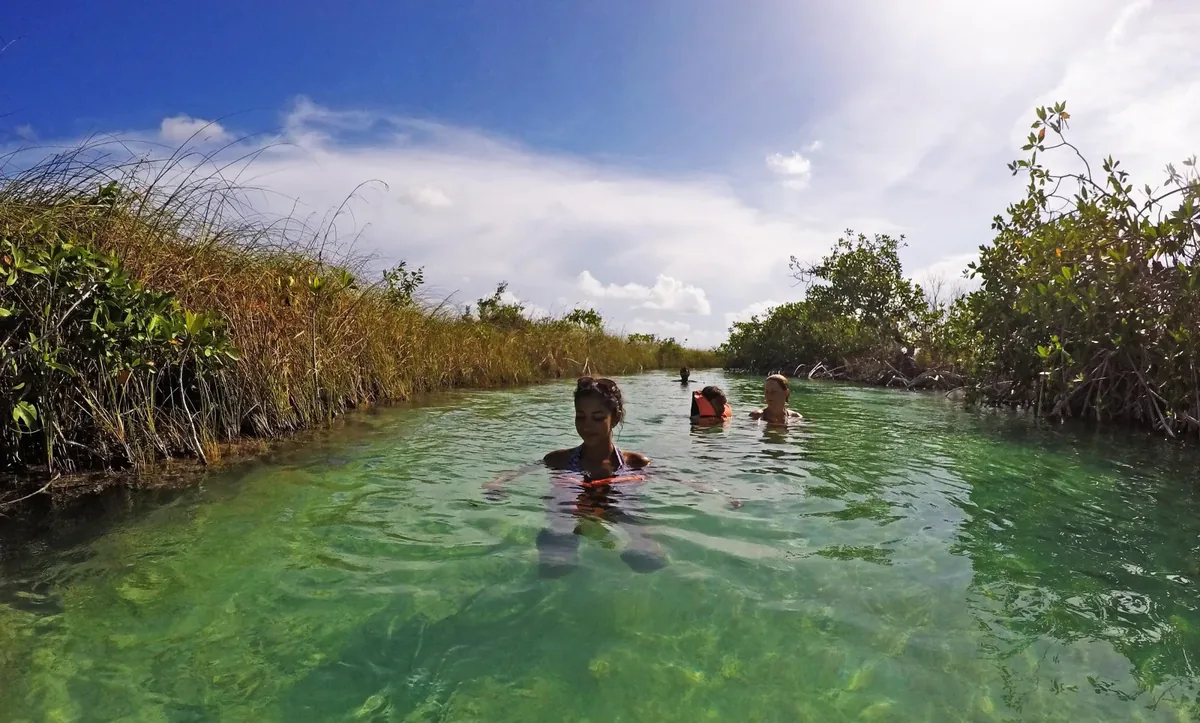
Twenty minutes south of the ruins, the Riviera Maya’s manicured tourism strip gives way to something else entirely: 528,000 hectares of unbroken wilderness, protected by UNESCO, running from jungle through mangrove wetlands to a living stretch of coral reef.
This isn’t a second ruins site, and it isn’t a beach day. It’s a landscape, and it’s the best nature pairing you can add to a Tulum trip if this kind of thing appeals to you. The half-day tour below combines the Muyil ruins with the lagoon boat and the canal float, with hotel pickup in Tulum:
What Sian Ka’an Is
Sian Ka’an means “Where the Sky Is Born” in Maya, and the name suits it. Established as a biosphere reserve by presidential decree in 1986 and inscribed as a UNESCO World Heritage Site the following year, it’s the largest protected area in the Mexican Caribbean: roughly 408,000 hectares of forest and wetland on land, plus another 120,000 hectares of protected marine reserve, stretching some 120 kilometres along the coast south of Tulum.
What earns a reserve this designation is completeness. An unbroken chain runs from inland tropical forest, through freshwater cenotes and wetlands, out across coastal lagoons, to a section of the Mesoamerican Barrier Reef, the second-largest reef system on Earth. UNESCO’s citation also recognises its human layer: 23 registered Maya archaeological sites sit within the reserve, and the canals the Maya engineered centuries ago still carry water, and visitors, today.
That is what separates Sian Ka’an from everything else in this cluster. Akumal is a single wildlife-encounter bay. Cobá is a second archaeological city. Sian Ka’an is an ecosystem.
Other Experiences You Might Enjoy
A Tulum base puts a lot within reach besides the reserve. The sea turtles of Akumal, the climbable jungle pyramid at Cobá, the freshwater cenotes and cave systems along the Cobá road such as Dos Ojos, the reef diving off Puerto Morelos, and the long day inland to Chichén Itzá and colonial Valladolid are all day trips from a Tulum or Riviera Maya base. Current availability and pricing for these and other experiences along this stretch of coast are below.
Getting There, and How Access Works
The Muyil side is the practical gateway most visitors use: about 20 to 25 minutes, roughly 24 km, south of Tulum on Highway 307. It’s a straightforward, paved drive, and this is the entrance nearly every “Sian Ka’an from Tulum” tour uses.
The Punta Allen side, reached via a rough dirt road, is a different proposition entirely: 2.5 to 3 hours on a track best suited to a 4x4 or an organised tour, and the base for fly-fishing and more remote marine wildlife. The two sides sit more than two hours apart and can’t be combined in a single day.
Access here works differently than at Tulum or Cobá, so understand it before you plan. You can drive to Muyil independently, pay the entrance fees, and walk the jungle boardwalk on your own; that part is self-guided. But the lagoon boat ride and the signature canal float can only be operated by a licensed community boat cooperative. There’s no self-drive boat option here. Most visitors book an organised tour that bundles transport, all the fees, a certified guide and the boat itself, a real contrast to the DIY-friendly model at Tulum or Cobá. The Muyil ruins and Sian Ka’an lazy river tour from Tulum is built that way: hotel pickup in Tulum, entry fees, a certified guide, the lagoon boat, the river float with a life jacket, a snack and Mexican tacos, rated 4.8 from 439 reviews, from $219.
The Classic Sian Ka’an Experience
A typical half-day unfolds in four parts.
The Muyil ruins come first: a compact, jungle-shrouded archaeological site, walkable in 30 to 60 minutes.
The Canan-Ha boardwalk follows, an elevated wooden trail through wetland jungle, roughly 500 metres, with an observation tower offering a rare aerial view over the lagoon before it delivers you to the boat dock.
A lagoon boat ride carries you across the Muyil and Chunyaxché lagoons and into mangrove-lined channels, your guide pointing out birds, crocodiles and the mangrove ecology as you go.
The float itself is the reason people come. At a small lagoon-side structure once used as a Maya waystation, you put on a mandatory life jacket and drift a channel the Maya originally dug as a trade route, carried by a gentle current for roughly 40 minutes through tunnels of mangrove. It’s consistently described as one of the most peaceful things you can do in this entire region, and it works well for families too.
What You’ll See
Sian Ka’an is one of the premier birding destinations in the Yucatán, with regional surveys recording as many as 375 species. UNESCO’s own count is more conservative: “more than 300, of which 120 are migrants.” Either way, birds are close to a sure thing on any visit.
Watch for roseate spoonbills, the bay’s signature pink wader, alongside frigatebirds, white ibis, wood storks, and sixteen species of heron and egret nesting in the mangroves. Ospreys maintain a healthy breeding population, and the reserve holds a small colony of jabiru storks, the tallest flying bird in the Americas. Winter, roughly November through March, adds North American migrants to the mix and is your best window for diversity.
Beyond birds, the reserve holds American and Morelet’s crocodiles, and, much more rarely, West Indian manatees, bottlenose dolphins and sea turtles in the bay areas, plus spider and howler monkeys inland. Set your expectations honestly: birds show up on nearly every trip, dolphins and turtles on most marine-side outings, crocodiles perhaps a third to half the time depending on season, and manatees only occasionally. This is wildlife observation and no guaranteed encounter, which is part of what makes it rewarding.
Muyil, the Ruins Themselves
Muyil, also called Chunyaxché, holds a distinction that sets it apart from most of the sites in this cluster: it’s one of the earliest and longest continuously inhabited Maya sites on this coast, with evidence stretching from roughly 350 BCE through 1500 CE. That’s a long occupation, unusual in a region mostly dominated by later Postclassic coastal cities.
Its architecture reflects that history. Steep-walled pyramids in a Petén style reminiscent of Tikal point to strong inland trade ties with Cobá, about 44 km to the northwest. Muyil functioned as a maritime trading port, and goods moving through its canals once included jade, obsidian, cacao, honey, and chewing gum harvested from the surrounding forest.
The main pyramid, El Castillo, stands 17 metres, one of the taller structures on this stretch of coast though well short of Cobá’s climbable Nohoch Mul, and like every structure here it’s roped off and not climbable.
The site reopened in February 2026 after a lengthy INAH-led restoration, during which archaeologists uncovered a steam bath, a collapsed vault holding a ceramic vessel depicting a god in full headdress, and a complete jade-and-shell pectoral necklace. New parking, restrooms and signage came with the reopening. Budget 45 to 60 minutes for the ruins loop before you head to the boardwalk.
Combining Sian Ka’an With the Tulum Ruins
Because Muyil sits only 20 to 25 minutes from Tulum and both archaeological sites are compact, pairing them in a single day is realistic, though it’s a full, active day. Operators commonly package exactly this: the Tulum ruins in the morning, lunch, then Muyil, the lagoon boat and the canal float in the afternoon.
Our recommended order: Tulum ruins first, at opening, to beat the heat and crowds as we cover in our best-time-to-visit guide, then head south for the Sian Ka’an afternoon. The Sian Ka’an tour we feature doesn’t include the Tulum ruins, and no single listing in our inventory bundles the two, so this is two bookings. That works well in practice because its published program starts with an early-afternoon hotel pickup in Tulum. Book the Tulum Archaeological Zone Guided Walking Tour for the morning (1 hour 15 minutes with a certified guide and beach access afterwards, rated 4.9 from 110 reviews, from $17), check the pickup time on the Sian Ka’an listing for your date, and leave a lunch gap between the two.
If you’re drawn to the Punta Allen side instead, treat it as its own dedicated day. Don’t try to combine the long dirt-road drive with a Tulum ruins morning; the logistics don’t fit together.
Compare Tulum ruins tours and combos →
Fly-Fishing: A Separate World
Ascension Bay, near Punta Allen, is world-renowned among fly anglers for bonefish, permit, tarpon and snook, so it deserves a mention even if it’s not your trip. The reserve’s vast, shallow flats and long-standing artificial-lure-only rules have kept the fishery in excellent condition, and Punta Allen is often called the permit capital of the world. This is a dedicated, lodge-based, multi-day pursuit entirely separate from the half-day Muyil boat tour most visitors do. Plan and budget for it as its own trip if it interests you, and not as an add-on to a ruins day.
Practical Guidance
Best time to go: the dry season, roughly November through April, for the clearest lagoon water and easiest roads, with winter adding the bonus of migratory birds. Early morning and late afternoon are your best windows for wildlife regardless of season.
One useful fact for trip planning: the lagoon and float are entirely unaffected by sargassum, since they’re inland freshwater and brackish systems and not open coast. If your visit falls during a heavy sargassum stretch (our seasonal guide has the context), Sian Ka’an becomes an excellent fallback that the coast can’t offer.
What to bring: a swimsuit, a quick-dry towel, a hat and long sleeves in place of sunscreen (more on that below), natural insect repellent applied before you arrive, plenty of water, and cash, because the community cooperative fees are cash-only and there’s no cell service once you’re in the reserve.
The sunscreen rule is stricter here than almost anywhere else in this cluster. Even biodegradable sunscreen is prohibited in the water, protecting the mangroves and the reef beyond them. Cover up with clothing instead of relying on sunscreen for this part of your trip.
Fitness and accessibility: easy. The boat ride and the float require no real exertion, and the boardwalk is a flat, straightforward walk, which makes this one of the more accessible activities in the entire region. Minimum ages for the float commonly run around five or six; confirm with your specific operator.
Safety: crocodiles are present in the reserve, though the managed float areas have an excellent safety record when guide instructions are followed. Keep a respectful distance from any wildlife you encounter, and remember the remote setting means minimal facilities: no showers at the docks, and no phone signal once you’re in.
Conservation and Responsible Tourism
The way Sian Ka’an is managed is part of its story.
Tourism revenue here is deliberately channelled into conservation and local Maya livelihoods through a community-cooperative model, uniting ecotourism cooperatives that work directly with the Muyil and Punta Allen communities. A dedicated destination initiative organises over a dozen cooperatives across nine communities, and a nonprofit founded specifically to protect the reserve channels private conservation, research and education funding. When you book through a licensed community operator, your money supports the people conserving this land. That is the actual model and no incidental side effect.
The threats to Sian Ka’an are real and current, and it would be dishonest not to mention them. Conservation authorities have flagged the cumulative pressure of regional development (the Maya Train, the nearby international airport and other coastal infrastructure projects) as likely to compound existing tourism pressures on the reserve. The highway between Cancún and Tulum records Mexico’s highest jaguar mortality rate, and Tulum’s own rapid growth brings runoff and aquifer stress right to the reserve’s edges.
Responsible visiting is straightforward: no sunscreen or lotions in the water, never touch, feed or chase wildlife, stay on marked trails and designated boat routes, pack out everything you bring in, and choose licensed, community-based operators whenever you book.
Is Sian Ka’an Worth It?
Yes, for the right traveller.
If you’re drawn to birding, photography, or a calm, crowd-free encounter with a wild ecosystem, nothing else near Tulum compares. You get a UNESCO-scale wilderness, the singular experience of floating a Maya-built canal, and real conservation value behind your visit.
But be honest with yourself about the trade-offs. This demands more time and more logistics than a cenote stop, it depends on a guide instead of working as a DIY day, and it isn’t a beach day or a swim-with-turtles outing. If your priority is a quick, refreshing swim or minimal planning, you’ll get more satisfaction from Akumal or a nearby cenote. If you want a second dose of Maya archaeology with a pyramid you can climb, Cobá is the better fit. Sian Ka’an wins decisively on wildness and tranquillity; it just asks more of you to get there.
Frequently Asked Questions
Is Sian Ka’an worth visiting from Tulum? Yes, especially for nature and birding enthusiasts. Travellers mainly wanting a swim or minimal logistics are better served by a cenote or Akumal.
Can you visit Sian Ka’an without a tour? Partially. You can drive to Muyil and walk the boardwalk independently, but the lagoon boat and canal float require booking through the licensed community cooperative.
How much does it cost to enter Sian Ka’an and Muyil? Entry involves separate INAH and federal reserve fees, plus a small community boardwalk fee. Figures have risen in recent years, so confirm current rates before you travel.
What is the Sian Ka’an “lazy river” float? A roughly 40-minute, life-jacket-required drift through channels the ancient Maya dug as trade canals, carried by a gentle natural current through mangrove tunnels.
What wildlife will I see? Birds on nearly every visit, including spoonbills, herons and frigatebirds. Crocodiles are common; dolphins, turtles and manatees are possible but not guaranteed.
Can you climb the Muyil pyramid? No. El Castillo, at 17 metres, is roped off like every other structure in this cluster.
When is the best time to visit? The dry season, November through April, for clear water and good roads. Winter adds migratory birds, and the lagoon is unaffected by sargassum regardless of season.
Can you do the Tulum ruins and Sian Ka’an in one day? Yes, on the Muyil side; it’s a natural full-day pairing. The Punta Allen side needs its own dedicated day.
Do I need cash? Yes. Cooperative and community fees are cash-only, and there’s no phone signal in the reserve.
Why can’t I wear sunscreen? Even biodegradable sunscreen is banned in the water here to protect the mangroves and reef. Cover up with clothing instead.
Plan Your Visit
For a wilder, quieter side of the Riviera Maya, Sian Ka’an is a good use of the extra logistics. Check dates and pickup times for the Muyil and lazy-river tour in the calendar above.
Browse Tulum ruins tours and combos →
Related: The complete Tulum ruins guide · Maya ruins of the Yucatán · Tulum + Akumal turtle snorkeling · Tulum + Cobá combo
Fees, hours and access rules verified August 2026. Reserve fees have risen in recent years and access is guide-dependent for boat activities, so confirm current rates and book through a licensed community operator. Ratings and review counts re-checked live on 19 September 2026 and will drift as new guests review.
Walk Through 800 Years of Maya History
Join guests who rated this guided walking tour 4.9/5. A certified local guide, skip-the-confusion entry, and beach access afterward — all included. Free cancellation.
Check Availability & Book