Visiting the Tulum Ruins Responsibly: A Guide to Sustainable Tourism
Is Tulum overtouristed? An honest look at the aquifer, the reef, sargassum science, and what your choices can do, with specific, practical guidance.
Tulum’s environmental strain is real, well documented, and mostly structural. Tourists dropping litter didn’t cause it; the speed and scale of development outrunning the infrastructure meant to support it did. That distinction shapes what your own choices can do here, and what they can’t.
This article is an honest attempt at both: the real story behind Tulum’s environmental and social strain, and specific guidance for visiting in a way that helps and doesn’t just perform. If you’d like a guide to explain what you’re looking at, and why the rules on the site matter, the guided walk below runs about 1 hour 15 minutes:
Is Tulum Overtouristed?
Short answer: it was, and the destination is now living through the consequences.
Between roughly 2015 and 2021, Tulum saw explosive, largely unregulated growth. Construction licences increased by a staggering margin, most of it without proper environmental review. What had been a small town of modest palapa hotels became a destination absorbing millions of visitors a year, much of it marketed as “eco-chic” while mangroves were cleared and cenotes filled in to make way for development.
The 2025–2026 tourism downturn is, honestly, partly self-inflicted. Trade press reported that coastal hotel occupancy fell sharply through 2025, that international flight operations dropped significantly year over year, and that multiple airlines scaled back or suspended routes. Industry figures interviewed pointed to overbuilding, steadily rising prices, and what one described as the destination’s “arrogance”, and not primarily to sargassum, though record seaweed years compounded an already-declining reputation. The honest read is a case study in what happens when growth outpaces trust and infrastructure, and not just bad luck with the weather.
Is the recent fee overhaul we cover in our ticketing guide genuine conservation reform, or revenue recovery? Fairly read, both. The July 2026 decree that cut entry fees and reorganised park access is explicitly framed as a tourism-rescue package, and it is one. It also carries forward real environmental commitments: an updated ecological programme, a sargassum-collection strategy, and operator certification requirements. Treat it as a revenue-recovery measure that has absorbed some of the language and substance of sustainability, prompted by the overtourism model it now partly reverses.
Other Experiences You Might Enjoy
The same limestone landscape produces a lot of what makes this coast worth visiting. The freshwater cenotes and cave systems along the Cobá road, the sea turtles of Akumal, the climbable jungle pyramid at Cobá, the Muyil ruins and the lazy-river float through the Sian Ka’an Biosphere Reserve, and the long day inland to Chichén Itzá and colonial Valladolid are all day trips from a Tulum or Riviera Maya base. Current availability and pricing for these and other experiences along this stretch of coast are below.
Why This Coastline Is Uniquely Fragile
To see why visitor behaviour matters more here than in most destinations, start with the ground you’re standing on.
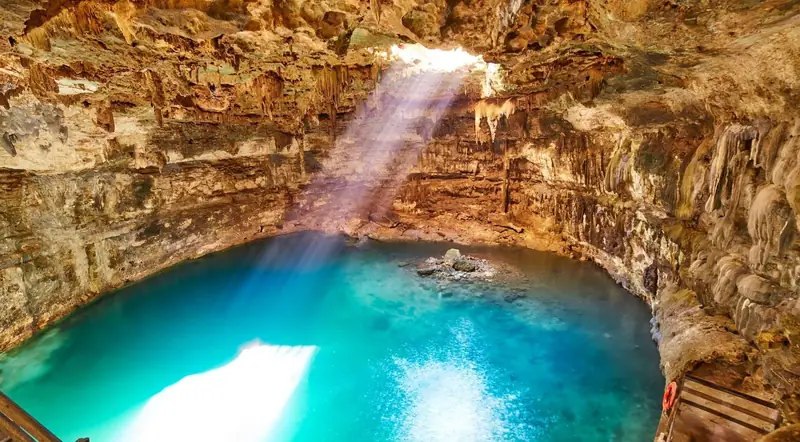
The Yucatán Peninsula is a flat limestone platform with essentially no surface rivers. Rainwater doesn’t run off into streams; it sinks straight through porous rock into a single, vast, interconnected underground river system. Cenotes, covered in depth in our cenotes guide, are windows into that aquifer.
The practical consequence is stark: there is almost no soil filtration between the surface and the water everyone swims in, drinks, and depends on. Whatever goes onto the ground here (sewage, sunscreen, construction runoff, fertiliser) reaches the aquifer, the cenotes, and eventually the reef, fast.
That is why the sewage story matters so much. As of 2025, Tulum’s municipal sewage coverage stood at just under 60%. A substantial share of homes and businesses still discharge wastewater into septic pits or informal soakaways that connect directly to the same aquifer feeding the region’s cenotes and coastline. This one infrastructure gap sits behind much of what follows.
The Real Environmental Issues
Cenote water quality
Mexico’s health regulator has repeatedly flagged specific Tulum cenotes, including some of the most visited, for bacteria levels above safe thresholds, a finding our cenotes guide covers in more detail. Peer-reviewed research has found visitor numbers correlate directly with contamination indicators at popular sites. The practical takeaway: shower before entering any cenote, never bring lotion or sunscreen into the water, and treat easily accessible roadside cenotes with somewhat more caution than remote, lower-traffic ones.
The reef
A 2024 comprehensive assessment of the Mesoamerican Reef, the second-largest reef system on Earth, which runs along this coast and features in our Sian Ka’an guide, found the majority of monitored sites in poor or critical condition, following the worst regional coral bleaching event on record. There was one bright spot: overall reef health improved slightly for the first time in five years, driven by stronger enforcement of fishing rules that let herbivorous fish populations recover. Those fish graze the algae that otherwise smother coral. The reef’s dominant threats are climate-driven bleaching and nutrient pollution from the same sewage gap described above, a direct line back to Tulum’s infrastructure story.
Sargassum: the science, honestly
This deserves a clear answer, because it’s often misunderstood: the sargassum blooms affecting this coast are not caused by Tulum’s tourism, and nothing an individual visitor does changes them.
For years, the leading explanation pointed to agricultural runoff from major river systems and shifting ocean currents. Recent research, using more than a century of coral-core records, has reframed the picture, pointing instead to large-scale equatorial ocean upwelling patterns as the dominant driver of the modern sargassum surge. The researchers note that runoff alone cannot explain the scale of the increase seen since 2011, and they also acknowledge some remaining uncertainty. This is a large, climate-linked oceanographic phenomenon and not a local pollution problem. Our seasonal guide covers the practical side of planning around it.
Wildlife
Highway 307, the road connecting Cancún, Playa del Carmen and Tulum, cuts directly through jaguar, puma and spider monkey habitat, and has one of the highest documented rates of jaguar roadkill in the country, which has prompted a state wildlife-crossing project now underway. Separately, Tulum’s beaches south of the hotel zone are active sea turtle nesting sites for much of the year, and research consistently shows artificial light disorients hatchlings and deters nesting females from coming ashore at all. If you’re on the beach at night during nesting season, keep lights off, don’t use flash photography, and never touch a nest or a hatchling.
Single-use plastic
Quintana Roo passed a state law restricting single-use plastic bags, straws and related items, though enforcement has been inconsistent. There’s no comprehensive federal ban in Mexico. Inside protected areas, including Parque del Jaguar, single-use plastic bottles are restricted, in line with rules across Mexico’s protected natural areas generally.
Reef-Safe Sunscreen: What Works
This is the single highest-leverage thing an individual visitor controls, so get it right.
“Reef-safe” is an unregulated marketing term. There’s no official certification behind it, and testing has repeatedly found products labelled “reef safe” still containing the ingredients they claim to avoid. Read the active-ingredients panel, not the front of the bottle. The ingredients with the strongest evidence of coral harm are oxybenzone and octinoxate, so avoid both. A reef-safe sunscreen lists non-nano zinc oxide or non-nano titanium dioxide as its only active ingredient.
In cenotes specifically, the safest approach is no sunscreen at all. Shower beforehand, and rely on a UPF rash guard and a hat instead. That matches the stricter rule in our Sian Ka’an guide.
One honest caveat: researchers debate sunscreen’s relative impact. Laboratory studies show real harm at low concentrations, but climate-driven bleaching remains the dominant threat to the reef overall. Switching your sunscreen is within your control and does some good, though it doesn’t replace addressing the larger climate story.
Where Your Money Goes
This matters more than most visitors realise, and it’s within your control.
Studies of enclave-style, all-inclusive destinations generally find that a large share of tourist spending flows straight back out of the local economy, to foreign ownership, imported supplies and corporate management, and not to the community hosting you. That’s a general industry pattern and not a measured Tulum figure. Spending with locally owned hotels, independent restaurants and community-run operators keeps far more of your money circulating locally.
A quick note on how land and fees work here, since it recurs across this cluster. Much of the land outside Tulum’s built-up tourist strip is ejido land, communally held by Maya communities under a system dating to Mexico’s post-revolutionary land reforms. Our cenotes guide notes that several of the inland cenotes are ejido-managed, and that is part of why a fee paid there, or on a boat-cooperative outing like the Sian Ka’an float, reaches local communities in a way a resort’s fee doesn’t. If that’s the kind of day you want, the Muyil ruins and Sian Ka’an lazy river tour from Tulum is rated 4.8 from 439 reviews, from $219; ask the operator who runs the boat, as our Sian Ka’an guide explains.
It would be dishonest to skip the friction here too. The same land-reform system that lets communities benefit from tourism has also enabled contested land sales and pressure toward privatisation along this coast. Community-based, cooperative-run tourism is best understood as a real corrective to that pressure, and no mere feel-good label.
Practical Guidance for Your Visit
At the ruins, staying on marked paths and not touching structures isn’t an arbitrary rule. It’s heritage preservation, and Tulum’s stucco figures and murals, which our structures guide walks through, are delicate. Every visitor who respects the barriers is part of what keeps them intact.
On a ruins, cenote, or beach day: carry a refillable water bottle instead of buying single-use plastic, decline plastic straws and bags where offered, and pack out anything you bring in.
Cultural respect, made specific: Tulum sits on land that remains significant to living Maya communities and is more than a backdrop for ancient history. Equinox ceremonies still take place here, and Maya languages are widely spoken across the region. Hiring Maya and local guides, buying directly from artisans and not from resold souvenirs, and asking before photographing people are concrete ways to show respect. “Wellness,” temazcal and shamanic experiences are frequently commercialised for tourists in ways disconnected from their cultural context, and a community-run version is a meaningfully different thing from a resort-packaged one.
Choosing operators without falling for greenwashing: look for genuine third-party certification and not self-declared “eco” branding. Mexico’s national sustainability recognition programme and internationally recognised certifications like Rainforest Alliance are good things to ask about directly. A legitimate operator can tell you specifically how they treat wastewater and whether their guides and staff are local hires. A greenwasher tends to deflect the question or point back to marketing language.
What Your Choices Can and Can’t Do
It helps to be direct about this and avoid either extreme.
Your individual choices cannot fix Tulum’s sewage infrastructure gap, halt the sargassum, or reverse coral bleaching. These are systemic, and in sargassum’s case largely beyond any tourist’s influence. No article should pretend otherwise.
What your choices can do: reduce your own direct footprint through the sunscreen, plastic and water decisions above; shift where your money goes, toward the local and Indigenous economy and away from the resort economy; and respect the wildlife and heritage rules that protect a fragile place. None of that is a complete solution, and all of it is real.
Frequently Asked Questions
Is Tulum overtouristed in 2026? It was, at its peak, and the destination is now navigating the consequences of that growth. The ruins themselves can still feel crowded at midday, but the wider destination is quieter than it was at its height.
Is it ethical to visit Tulum right now? Yes, provided you spend thoughtfully. Tourism revenue that reaches local and Indigenous communities supports both livelihoods and conservation.
What sunscreen is reef-safe? Look for non-nano zinc oxide or non-nano titanium dioxide as the sole active ingredient. Ignore “reef-safe” front-label claims and check the ingredients panel instead. Skip sunscreen entirely in cenotes.
Can I safely swim in Tulum’s cenotes? Generally yes at well-managed sites. Shower before entering, use no lotion of any kind, and take extra care at heavily trafficked roadside cenotes.
Is sargassum caused by tourism or pollution? Not by tourism. Current research points mainly to large-scale ocean and climate patterns, and finds that runoff alone can’t explain the increase, though some uncertainty remains.
How do I choose a sustainable hotel or tour operator? Ask directly about wastewater treatment and local hiring practices, and look for recognised third-party certification and not self-described “eco” branding.
Do cenote and site fees help local communities? At ejido and cooperative-run sites, yes, meaningfully. Fees paid to large corporate resorts leak much further out of the local economy.
What are the rules at the Tulum ruins, and why do they matter? Staying on marked paths and not touching structures protects the site’s delicate stucco figures and murals. It’s preservation and not bureaucracy.
Visit Thoughtfully
Tulum’s fragility is real, and so is the value of visiting well. The two aren’t in conflict. Check dates and start times for the guided walk in the calendar above, or compare every guided option before you choose.
Related: The complete Tulum ruins guide · Tulum ruins and cenote tours · Sian Ka’an Biosphere Reserve · Is Tulum safe?
Environmental and sustainability information verified August 2026 against current research and reporting. Some figures, particularly around infrastructure and fees, change as local policy evolves. Ratings and review counts re-checked live on 19 September 2026 and will drift as new guests review.
Walk Through 800 Years of Maya History
Join guests who rated this guided walking tour 4.9/5. A certified local guide, skip-the-confusion entry, and beach access afterward — all included. Free cancellation.
Check Availability & Book