Inside the Tulum Archaeological Zone: What You'll See
Tulum isn't an ancient city — it's a late, walled Maya trading port built around 1200-1450 CE. Here's what each structure meant, and what the archaeology actually tells us.
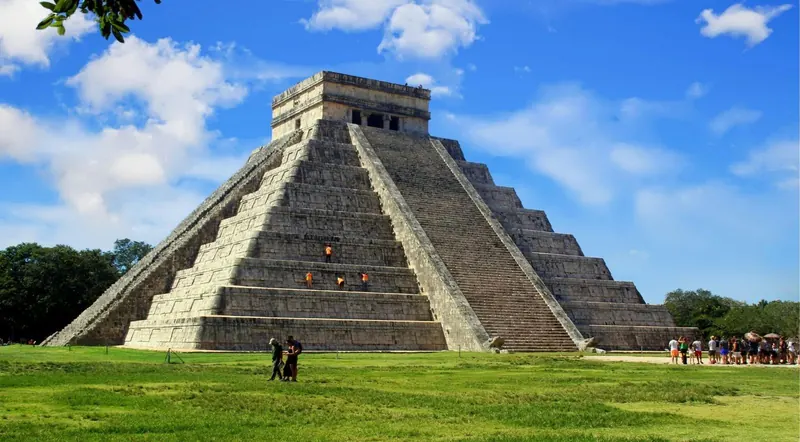
Here’s the fact that reframes everything else about a Tulum visit: this is not an ancient city.
Most of what you’ll see was built between roughly 1200 and 1450 CE — centuries after Tikal, Palenque, and the other great Classic-period cities had already been abandoned. Tulum belongs to a different, later chapter of Maya history: a walled, commercially-minded coastal port that was still a functioning city when the Spanish first sighted it in 1518.
Understanding that single fact changes how you look at everything here. This isn’t a monument to a vanished golden age — it’s a snapshot of the Maya world exactly as it stood at the edge of European contact. It’s also the kind of context a certified guide supplies in an hour and the site’s own signage largely doesn’t:
A City From the Wrong Part of History
To place Tulum correctly, you need the Postclassic period — roughly 950 to 1521 CE — which followed one of history’s most debated societal shifts: the Classic Maya collapse. Between about 800 and 1000 CE, the great southern lowland cities were progressively abandoned. Scholars still argue over how total that collapse really was, but what’s clear is that Maya power shifted north and toward the coast, and the political model changed with it. Classic-era cities ran on divine kingship and monumental building; the Postclassic world ran increasingly on trade.
Tulum is a product of exactly that world — small, fortified, and built around commerce rather than dynastic monument-building. Its main structures date to the 13th through 15th centuries. There’s a hint of earlier activity: a stela on site carries a date of 564 CE, but the scholarly consensus is that the stone was likely brought to Tulum from an older location rather than marking the city’s own founding. Tulum’s real story begins later, and it runs right up to Spanish contact.
Other Experiences You Might Enjoy
Before the walk itself, a note on the rest of the region. Tulum was a node in a network, and several of the places named in its story are visitable today: Cobá, the inland city this port most likely served, 45 minutes away and home to a climbable pyramid; Chichén Itzá, whose serpent-column style shows up in Tulum’s own El Castillo; the Muyil ruins and the Sian Ka’an Biosphere Reserve to the south; and the cenotes and Akumal turtle bay along the same coast the Chontal traders worked. Current availability and pricing for these and other Tulum-area tours are below.
What Was This Place Called?
You’ll often see Tulum’s “original name” given confidently as Zamá, meaning dawn or morning. It’s a reasonable and well-documented attribution — but it deserves a more careful treatment than most sources give it.
“Tulum” itself means wall, fence, or palisade in Yucatec Maya, and Mexico’s national anthropology institute is explicit that this name was applied after the city’s abandonment, likely by 19th-century visitors describing the still-standing fortification. It was never the city’s own name for itself.
“Zamá” appears in 16th-century colonial sources, tracing back to a 1639 account by a colonial cleric who described “the coast of Zama.” It’s a documented, plausible older name — and a fitting one for an east-facing cliff city that catches the sunrise — but the record runs through early colonial writing rather than a pre-conquest inscription. Treat it as the probable older name, not a certainty carved in stone.
Tulum the Trading Port
Tulum’s importance was economic, not monumental. It functioned as a coastal port, most likely serving the large inland city of Cobá roughly 40 km to the northwest — a relationship you can trace today by visiting both sites, since Cobá and Tulum pair naturally as a single day.
The Postclassic Caribbean coast ran on canoe-based trade, dominated by Chontal Maya seafarers sometimes called “the Phoenicians of Middle America.” Columbus’s own crew described encountering one of their trading canoes in 1502 — roughly 15 metres long, paddled by 25 people. Goods moving along this network and confirmed by artifacts at Tulum included obsidian carried nearly 700 km from highland Guatemala, jade, copper ornaments from western Mexico, cacao, cotton textiles, salt, and honey — a genuinely valuable Yucatecan export that, as you’ll see below, may be woven directly into the site’s most mysterious carving.
The small cove at the base of the cliff let canoes land safely, and — critically — a natural gap in the offshore reef gave boats safe passage through. That gap is not incidental to where the city sits. It’s the reason.
When the Spanish Arrived
In 1518, the expedition of Juan de Grijalva sailed along this coast. Its chronicler, Juan Díaz, recorded seeing near sunset “a town or village so large that the city of Seville could not seem bigger or better,” with “a very large tower” visible from the water. Mexico’s anthropology institute considers this most likely to have been Tulum — then, in its account, “densely populated” and “apparently the principal city of an independent province.”
The Seville comparison was almost certainly the exaggeration of an astonished sailor rather than a literal measure — but the account matters for a different reason. It confirms Tulum was still a living, functioning city more than a quarter-century after Columbus’s first voyage, one of the last Maya cities still occupied at the moment of contact. By 1579, colonial records described it as already in ruins, likely emptied by disease introduced through contact rather than conquest.
The site was rediscovered for the wider world in 1841–42, when American traveller John Lloyd Stephens and British artist Frederick Catherwood visited and documented it — Catherwood’s precise engravings, published in Stephens’s Incidents of Travel in Yucatan, are what first put Tulum on the map for outsiders.
Walking the Site: What Each Structure Meant
The walled precinct is compact — on the order of 380 by 170 metres — so unlike the sprawling inland cities covered in our guide to the region’s other Maya sites, you’ll see everything worth seeing in about 90 minutes of relaxed walking.
El Castillo — the pyramid on the cliff
The tallest structure at Tulum, standing about 7.5 metres — modest by Maya standards, but its power comes entirely from its position, perched on the edge of the 12-metre cliff above the Caribbean. It was built in phases over an earlier structure, and its upper temple’s central doorway is flanked by two serpent columns — a stylistic borrowing from Chichén Itzá that hints at Tulum’s wider cultural connections.
The lighthouse question. You’ll frequently read that El Castillo functioned as a lighthouse, guiding canoes through the reef gap by firelight at night. This is a genuinely well-supported hypothesis — two small windows in the upper temple do align with the reef’s only navigable break, and the idea was seriously investigated by INAH researchers and the Institute of Nautical Archaeology in the 1980s. But it wasn’t El Castillo’s primary purpose; it was first and fundamentally a temple. Think of the beacon function as a plausible secondary role layered onto a religious building, not a settled fact.
You view El Castillo from the roped path and the clifftop overlook — climbing has been prohibited since 1994.
Temple of the Frescoes — the most important building here
If El Castillo is the postcard, the Temple of the Frescoes is the archaeology. Mexico’s anthropology institute calls it one of the most important surviving examples of Maya mural painting anywhere.
Built in stages — an early shrine, later wrapped in a colonnaded gallery, then a second story added on top — its interior murals, in black, green, yellow, blue and red, depict deities of both the underworld and the celestial realm. Scholars have identified figures including Chaac, the rain god, and Ix Chel, the moon and creator goddess, alongside serpents, maize, and ritual offerings.
The style is significant in itself: art historians classify these murals as part of the Mixteca-Puebla artistic tradition — a visual language shared across Oaxaca, central Mexico, and the Gulf Coast at exactly this late period, linking Tulum into a pan-Mesoamerican network right up to the eve of European contact. The corners of the building carry large stucco masks associated with Itzamná, the principal Postclassic creator deity.
You’ll see the exterior, the stucco masks, and a niche figure from the path; the interior murals themselves are protected and not easily visible up close.
Temple of the Descending God — an unsolved mystery
A small temple beside El Castillo, named for the striking stucco figure above its doorway: a winged being shown diving headfirst, arms outstretched, legs bent upward. The same motif appears on at least three other buildings at Tulum, an unusual concentration for such a small site — whoever this figure was, it mattered enormously here.
Who is it? There isn’t a settled answer, and it’s worth knowing the genuine range of scholarly interpretation rather than a single confident claim:
- The bee god, Ah Muzen Cab. Bees are shown in this exact diving pose in the Madrid Codex, and honey was economically central to this coast’s trade — a compelling, popular reading.
- A Venus deity. The figure carries the Venus glyph in the Dresden Codex, and one influential art historian identified it specifically as Xux Ek, the “Wasp Star” — the Maya’s Venus.
- The setting sun, rain, or lightning. Some archaeologists have cautioned that a descending celestial figure is a common Mesoamerican motif generally, and needn’t represent any one specific deity.
No interpretation has won out. That’s honestly part of what makes the figure worth pausing at — you’re looking at something the people who built it understood perfectly, and that we still don’t.
The elite quarters — House of the Halach Uinic and House of the Columns
Away from the temples, these two structures represent Tulum’s administrative and residential core. The House of the Halach Uinic (“House of the Great Lord”) combines a portico and columned entrance with an interior sanctuary bearing its own faded descending-deity figure. The House of the Columns, nearby, is one of the widest buildings on site — an L-shaped palace whose main entrance is divided by four columns into five bays. Both read as elite living and administrative space rather than purely ceremonial architecture — a reminder that Tulum was a functioning city with a governing class, not only a religious site.
Temple of the Wind God — the photograph
Perched on its own round base at the cliff’s edge, just north of El Castillo, this small temple is the single most photographed spot at Tulum, and for good reason — turquoise water and sand frame it on nearly every side.
The circular, corner-less design is linked by Mexico’s anthropology institute to Kukulcán in his wind-god aspect, equivalent to the central Mexican deity Ehécatl — round temples were built specifically to offer less resistance to the wind. A popular story holds that the structure doubled as a hurricane warning system, whistling audibly in high winds. It’s a nice detail, though harder to verify than the architectural association itself.
The wall that gave the city its name
Tulum is one of very few walled Maya cities, and it’s the wall — not any temple — that gave the site its modern name. The fortification runs along the north, south, and west sides of the precinct; the east needed no wall, since the cliff and sea did that job. Commonly cited figures put it at 3 to 5 metres high and up to 8 metres thick, roughly 400 metres along the side parallel to the coast and about 170 metres along each of the shorter sides. Five narrow gateways created defensible chokepoints, and two watchtowers stood at the western corners.
Why build it? Current thinking holds it served two purposes at once. The Postclassic period was politically turbulent, so straightforward defence is part of the answer — other cities of the era, including Mayapán, were walled too. But the wall also drew a hard line between the elite, sacred precinct inside and the ordinary population living outside it — a social boundary as much as a military one.
The House of the Cenote
In the northwest sector, a palace built directly over a small natural cenote — the freshwater source that made the walled city viable in the first place, and, in Maya belief, itself a sacred portal to the underworld. A rectangular tomb was found within the structure.
What You Can and Can’t Do
You cannot climb any structure or enter any building — that’s been the rule since 1994, and it’s strictly enforced. What you can do is walk flat, largely accessible paths through the whole precinct, photograph freely (a fee applies for professional camera equipment), take in the clifftop views, and, conditions permitting, descend the wooden stairway to the small beach below El Castillo.
There’s very little shade anywhere in the walled zone, so bring water and sun protection — our what to expect guide has the full packing list — and see our ticketing and hours guide for current fees and the 08:00 opening time. Arriving early is the single best way to see all of this without a crowd between you and it.
If you want the interpretation rather than just the view, a guide is what supplies it. The Tulum Archaeological Zone Guided Walking Tour in the calendar above covers the precinct in 1 hour 15 minutes with a certified guide — rated 4.9 from 110 reviews, from $17. For a slower, question-driven walk through the same material, a private guide to the Mayan ruins runs from $82 per group — worth knowing it rates 4.5 from 13 reviews, down from a perfect score on a smaller sample, so read the recent reviews first. Our format comparison covers the difference in detail, including hiring an accredited guide at the gate for cash.
Why This Small, Late City Still Matters
It’s worth returning to the framing question: why does a compact, comparatively young site like Tulum matter archaeologically?
Because it’s one of the best-preserved windows we have into the Postclassic Maya world — the world that actually met the Spanish, rather than the more famous Classic-era world that had already vanished centuries earlier. Tulum documents how power worked when it ran on trade instead of divine kingship, showcases a distinct “East Coast” architectural style (flat roofs on columns rather than the older Maya corbelled vault, small shrine-like temples, smooth painted stucco), and preserves some of the finest surviving Maya mural art anywhere, painted on the very eve of contact.
Recent Discoveries
Archaeological work at Tulum hasn’t stopped. In December 2023, INAH archaeologists clearing a new visitor path found a sealed cave, blocked by a boulder, containing multiple sealed burial chambers — reporting eventually identified as many as 11 individuals believed to be members of the city’s upper class, buried alongside abundant offerings. In one striking detail, researchers found that removing the boulder revealed the remains of a person who appeared to have been caught in the act of trying to enter, with the body split by the rock across the opening.
Separately, INAH completed a major conservation project on the site’s stucco Descending God figures and murals across seven structures, and 2024 saw the opening of the surrounding Parque del Jaguar and a new regional museum, reorganising how visitors move through the site today — covered in detail in our ticketing guide.
Frequently Asked Questions
How old is Tulum, really? The structures visible today were built mostly between roughly 1200 and 1450 CE — a late Postclassic Maya site, not an ancient Classic-period city like Tikal or Palenque.
Was Tulum originally called Zamá? Likely, though not certainly. Sixteenth-century colonial sources record the name Zamá, meaning dawn, for the site. “Tulum” is a later name, applied after the city was already abandoned.
Was El Castillo really a lighthouse? It was primarily a temple, but its design does align with the only navigable gap in the offshore reef — a genuinely supported theory that it also served a beacon function, not a proven fact.
Who is the Descending God figure? Unresolved. Leading interpretations include the bee god Ah Muzen Cab, a Venus deity, and a more general sun or rain association. No single reading is settled among scholars.
Why was Tulum walled, when most Maya cities weren’t? Most likely for both defence during a politically unstable period and to separate the elite, sacred precinct from the ordinary population outside it.
Can you go inside the temples or climb the pyramid? No — climbing and entering structures has been prohibited since 1994, strictly enforced across the entire site.
Did the Spanish really compare Tulum to Seville? Yes. A 1518 chronicle from Juan de Grijalva’s expedition describes a city “as large as Seville” — almost certainly Tulum, and almost certainly an exaggeration, but real evidence the city was still thriving at contact.
How long do you need to see everything? About 90 minutes at a comfortable pace — Tulum is compact compared to inland sites like Cobá or Chichén Itzá.
Before You Go
Understanding what you’re looking at is the difference between an interesting walk and a genuinely memorable one. For the practical side of planning your visit — fees, hours, and how to get there — see our complete Tulum ruins guide.
Ready to book? Check availability for the guided walking tour above, or compare every tour type and departure point in the complete guide.
Related: the complete Tulum ruins guide · what to expect on the day · Tulum ruins tickets and entry fees · Maya ruins of the Yucatán — which to visit · Tulum and Chichén Itzá compared
Historical and archaeological information verified against INAH and academic sources, August 2026. Scholarly interpretation continues to evolve on several points noted above. Ratings and review counts re-checked live on 25 August 2026 and will drift as new guests review.
Walk Through 800 Years of Maya History
Join guests who rated this guided walking tour 4.9/5. A certified local guide, skip-the-confusion entry, and beach access afterward — all included. Free cancellation.
Check Availability & Book